image
Definition & Why It Matters

Digital Employee Experience, Explained

When workplace technology works well, employees thrive. When it doesn’t, productivity suffers.

Digital Employee Experience (DEX) measures how employees experience their devices, applications, networks, and IT support.

Digital experience is now a competitive edge. When apps lag or tools fail, productivity and satisfaction take a hit.

With the right visibility, IT teams can act faster, reduce disruption, and keep work moving.

Teneo’s Managed DEX turns insight into real improvements employees feel every day.

Challenges

The Biggest Digital Employee Experience Challenges IT Teams Face

icon
Reactive Visibility
Issues that only surface after employees complain
icon
Tool Sprawl
Too many disconnected monitoring tools and alert noise
icon
Slow Troubleshooting
Slow troubleshooting across endpoints, apps, and networks
icon
Service Desk Overload
Overloaded service desks and repeat incidents
icon
No consistent measurement
No clear way to measure digital employee experience consistently across regions

Teneo Managed Digital Employee Experience (DEX) brings clarity, so IT can support employees everywhere with confidence.

Let's Talk

Outcomes

How to Improve Digital Employee Experience Across Your Organization


Employee typing on a laptop keyboard in a modern office workspace, representing a productive digital employee experience enabled by reliable technology.


Improving digital employee experience (DEX) isn’t about collecting more data, it’s about understanding what matters and acting on it.

With Teneo Managed DEX, IT teams can:

icon
Improve endpoint performance monitoring across devices and hybrid teams
icon
Prioritize issues faster using AI-enabled monitoring insights
icon
Automate response through runbooks, with or without a human-in-the-loop
icon
Optimize software licensing and application spend based on real usage
icon
Move from SLAs to XLAs that reflect true employee experience outcomes
icon
Support Green IT initiatives by reducing digital waste and inefficiency
icon
Quantify the value of technology investments during pilots and rollouts

This is how modern IT moves from reactive support to proactive digital employee experience management worldwide.

Differentiation

Managed Digital Employee Experience That Delivers Real Outcomes

Go beyond dashboards with digital employee experience delivered as a service.

Use Cases

Where Managed DEX Makes the Biggest Impact

The Highest-Impact DEX Use Cases

Service Desk Experience Optimization
Experience-Based Hardware Refresh Planning
User Productivity
Cost Analysis
End User Experience Monitoring for Critical Apps

Improve support with digital experience insights and faster resolution.

Digital Employee Experience dashboard showing service desk experience insights to help IT teams identify issues faster and improve support resolution times.

Digital Employee Experience insights help service desk teams identify issues faster and improve IT support resolution times.

Refresh endpoints based on experience data, not lifecycle age.

Digital Employee Experience dashboard analyzing endpoint performance to guide hardware refresh decisions based on real user experience data.

DEX analytics help IT teams prioritize hardware refresh decisions based on real employee device performance and experience data.

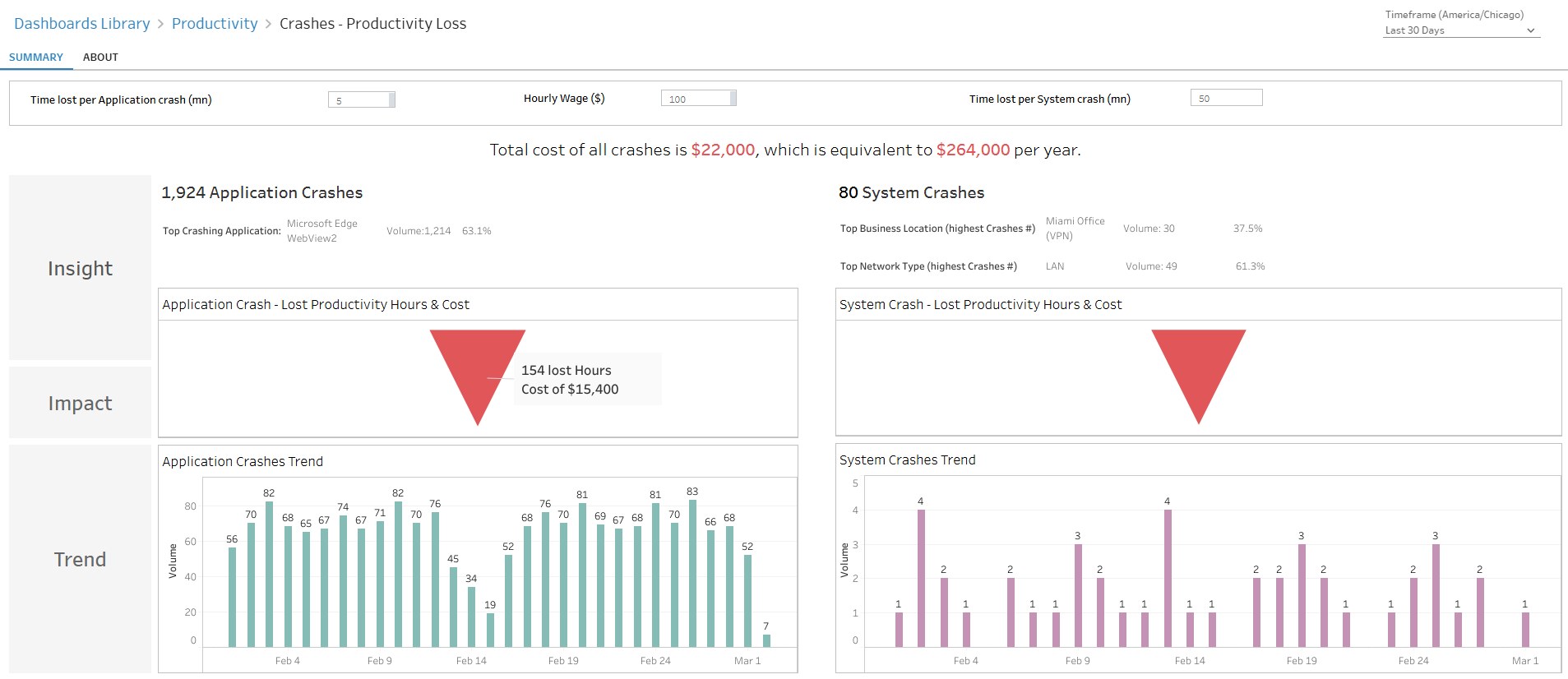
Boost user productivity through better digital experience.

Digital Employee Experience dashboard tracking employee productivity metrics and digital workplace performance across devices and applications.

Digital Employee Experience analytics help organizations identify technology issues that impact employee productivity.

Reduce wasted spend with usage-based software licensing insights.

Digital Employee Experience dashboard analyzing software usage and licensing data to help organizations reduce unnecessary IT spending.

DEX insights help organizations reduce wasted software spending through usage-based licensing visibility.

See application performance exactly as employees experience it.

Digital Employee Experience dashboard monitoring end-user application performance to ensure employees experience reliable access to critical business applications.

DEX monitoring allows IT teams to see application performance exactly as employees experience it.

Additional ways Managed DEX delivers value

Endpoint Performance Monitoring

Detect device health issues before employees feel the impact.

Collaboration and Remote Work Experience Support

Keep Teams, Zoom, and hybrid work running smoothly.

Mobile Workforce Experience Monitoring

Monitor mobile digital experience across devices, apps, and connectivity.

Software Adoption and Application Usage Visibility

Understand application usage to guide adoption and IT decisions.

Visibility Into Emerging Workplace Risks, Including Shadow AI

Identify unmanaged tools that affect performance, security, or compliance.

IT Experience Monitoring for Leadership Visibility

Turn DEX metrics into clear reporting and enterprise action.

How It Works

How Teneo Managed DEX Works

Teneo Managed DEX follows a structured approach to help IT teams assess, manage, and continuously improve digital employee experience.

icon
Strategy and Baseline
We align on your digital employee experience goals, KPIs, and priority use cases to establish a clear foundation for success.
icon
Deploy and Enable
We ensure the DEX platform is deployed, configured, and integrated effectively within your IT environment and workflows.
icon
Operate with Confidence
We support ongoing platform performance, adoption, and optimization so your teams have the insights needed to act quickly.
icon
Improve Over Time
We provide continuous recommendations, reporting, and best practices to strengthen digital employee experience management and drive measurable progress.

In the first 30 days, you gain clearer visibility, stronger adoption, and a foundation for continuous experience optimization.

Platform/Integrations

Powered by Riverbed Aternity, Integrated into Your IT Ecosystem

Real-time experience insights across endpoints, applications, and hybrid environments.

Teneo Managed DEX is powered by Riverbed Aternity, a leading digital employee experience platform that provides deep visibility into how employees experience technology across devices, applications, and networks.

riverbed

The platform delivers:

  • Real time insights into user workflows, app performance, and device health
  • AI-driven guidance to accelerate issue resolution and reduce service desk load
  • Digital experience scoring to track performance and improvement over time
  • Visibility across hybrid environments, including virtual desktops and remote work
  • Correlation of performance data with employee experience signals
  • Session replay to help IT teams visualize user experience and identify root causes

Service Desk Integration for Faster Action

Teneo Managed DEX integrates with leading IT service management (ITSM) platforms, including ServiceNow and Freshworks, connecting digital experience insights directly to service desk workflows for faster triage and resolution.

Proof

Digital Employee Experience Results in Action

Our customers love us.

  • quote Before working with Teneo, we were primarily working on a reactionary basis. Now, people right across the business are very impressed about how proactive we can be; they’ve never seen anything quite like it.
    Director of Architecture & Desktop, Leading US Law Firm
  • quote Since implementing our new strategy utilizing Teneo's Managed DEX service, we've seen happier users, quicker deployments & realized significant license cost savings.
    Head of IT Infrastructure & Operations, Global Engineering, Management & Development Consultancy
  • quote The desktop is the cause of a lot of problems, but most people are too busy looking somewhere else. We’ve found that if you simplify the network and remove capacity bottlenecks, it’s then easier to focus and improve the experience at the desktop, which in turn improves performance.
    Head of IT Infrastructure & Operations, Global Engineering, Management & Development Consultancy
FAQ

Managed Digital Employee Experience FAQs

Answers to common questions about DEX strategy, measurement, and managed services.

What is digital employee experience (DEX)?

Digital employee experience (DEX) is how employees experience workplace technology every day across devices, applications, networks, and IT support. Strong DEX keeps employees productive, while poor experiences increase downtime, frustration, and service desk demand.

What is Managed Digital Employee Experience (Managed DEX)?

Managed Digital Employee Experience (Managed DEX) is a service that helps organizations run and optimize their digital employee experience platform. Teneo Managed DEX supports adoption, configuration, and continuous improvement so IT teams can act on experience insights more effectively.

Why is digital employee experience important for IT teams?

Digital employee experience directly impacts employee productivity, customer responsiveness, and IT efficiency. When technology performance suffers, IT teams spend more time firefighting, and employees lose valuable time getting work done.

What are the most common digital employee experience challenges?

Common digital employee experience challenges include slow devices, application instability, collaboration disruptions, and limited visibility across hybrid environments. Many organizations also struggle with alert noise and inconsistent ways to measure experience across teams.

How do you measure digital employee experience?

Digital employee experience is measured through endpoint performance monitoring, application responsiveness, experience scoring, and real user impact. DEX platforms help IT teams quantify what a good experience looks like and track improvements over time.

How can IT teams improve digital employee experience?

IT teams can improve digital employee experience by proactively identifying issues, prioritizing fixes based on employee impact, and continuously optimizing device and application performance. Managed DEX helps teams turn experience data into consistent action.

What is the difference between DEX and end user experience monitoring?

End user experience monitoring (EUEM) focuses on how applications and devices perform for employees. Digital employee experience (DEX) is broader, combining performance insights with measurement, experience scoring, and ongoing improvement strategies.

What is endpoint performance monitoring and why does it matter?

Endpoint performance monitoring tracks the health and performance of employee devices, including CPU, memory, crashes, and application load times. It matters because endpoint issues are one of the biggest drivers of productivity loss and support tickets.

How does Managed DEX reduce service desk tickets and improve support?

Managed DEX improves service desk efficiency by providing clearer experience insights, reducing alert noise, and enabling runbook-driven response. IT teams gain the context they need to triage and resolve employee issues faster.

What industries benefit from Managed Digital Employee Experience (DEX)?

Managed DEX supports virtually any industry where employees rely on technology to do their work. It is especially valuable in financial services, legal, healthcare, education, engineering, manufacturing, and retail environments with complex or distributed IT needs.

Does Managed DEX integrate with ServiceNow or Freshworks?

Yes. Managed DEX can integrate with leading IT service management platforms such as ServiceNow and Freshworks. This helps connect digital experience insights directly into service desk workflows for faster action and better employee support.

How do we get started with Teneo Managed Digital Employee Experience?

Getting started is simple. Teneo begins with a consultation to understand your goals, then helps ensure your DEX platform is configured for success and delivering actionable insights. From there, we provide ongoing guidance and recommendations to continuously improve employee experience.

Cookie Policy
Teneo Logo

This website uses cookies so we can provide you with the best user experience possible.

Cookies are small files containing information that enables a website to recognise you. They’re downloaded to the device you use when you visit a website and sent back to that website each time you re-visit, or sent to another website that recognises the same cookie.

Our cookie policy tells you how and why we use cookies, and how this allows us to improve your online experience. You can read our full Cookie Policy here.

Strictly Necessary Cookies

Strictly necessary cookies include session cookies and persistent cookies. Session cookies keep track of your current visit and how you navigate the site. They only last for the duration of your visit and are deleted from your device when you close your Internet browser. Persistent cookies last after you’ve closed your Internet browser and enable our website to recognise you as a repeat visitor and remember your actions and preferences when you return.

Third Party Cookies

Third party cookies include performance cookies and targeting cookies. Performance cookies collect information about how you use a website, e.g. which pages you go to most often, and if you get error messages from web pages. These cookies don’t collect information that identifies you personally as a visitor, although they might collect the IP address of the device you use to access the site. Targeting cookies collect information about your browsing habits. They are usually placed by advertising networks such as Google. The cookies remember that you have visited a website and this information is shared with other organisations such as media publishers.

Keeping these cookies enabled helps us to improve our website and display content that is more relevant to you and your interests across the Google content network.